Dhanesh Amaresam — November 17, 2026
“He vivido aquí 71 años. No me quiero ir.”
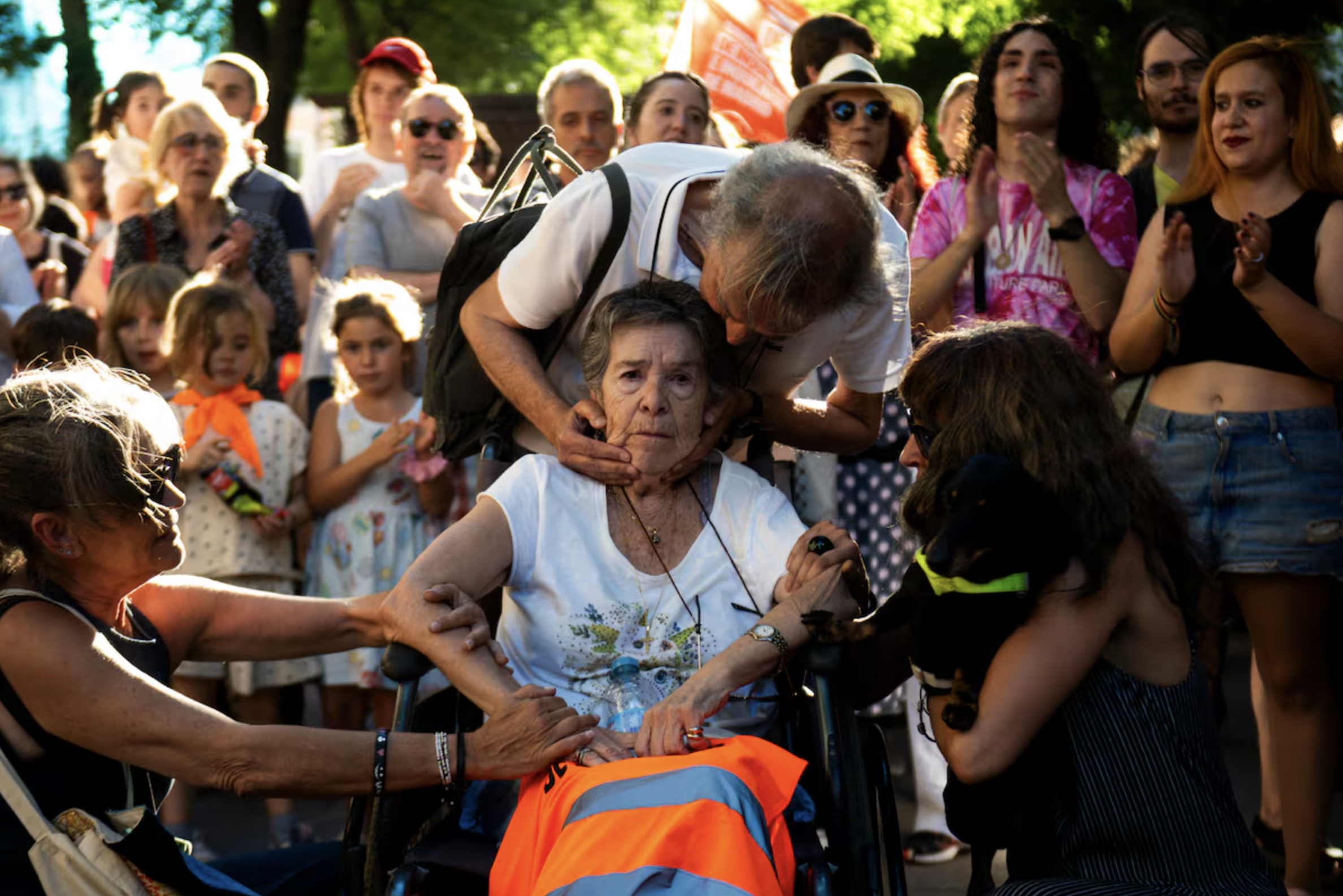
Those were the words of 87-year-old Maricarmen del Carmen Abascal, who is now a key symbol in Spain’s housing crisis. Moving in at the age of 17, she and her family lived at Calle Alcalde Sáinz de Baranda, 46 in the Retiro District in Madrid. She saw firsthand just how much this part of Madrid had changed within the span of seven decades — from a once quiet, affordable residential area to an affluent, unaffordable neighborhood.
“¡Maricarmen somos todas!”
“¡Maricarmen somos todas!”

On September 23rd, those were the rallying cries of dozens of protesters as they watched Maricarmen being evicted, carried out on stretcher, and forced to leave her home within the span of 30 minutes.
“¡Asesinos!”
In the midst of her eviction, a violent altercation ensued between protesters and police officers. Protesters gathered in formation, linked arms, and formed a human barricade around the property, and were met by baton charges and tear gas from roughly 200 national police officers.

“Expropiar a los rentistas.”
Urbagestión, who bought and rented Maricarmen’s apartment, is one of many investment companies seeking to profit from rising rents. Affordable public housing has been in short supply. Spain only has 318,000 public renting homes, accounting for only “1.72% of the total households,” which is near the very bottom of Europe’s public housing rate. The problem traces its roots back to the 1930s, following the Spanish Civil War, when dictator Francisco Franco promoted “mass construction of protected housing.” This was done to incentivize private ownership, popularizing housing as a sign of socioeconomic stability. In the words of Franco’s Housing Minister, “the regime did not want a Spain of proletarians, but of ‘propertarians.’” Between 1950 and 2012, Spain built over 6.8 million protected housing units with this strategy in mind. The problem was that the protected housing safety net established with the first generation of homeowners was not passed down to the next generations because price restrictions on the properties were temporary. Essentially, homeowners were able to sell their house for a huge profit, which drove government housing to become expensive private real estate that the government no longer controlled.
“Queremos vecinos, no turistas”
Back in 2023, President Pedro Sánchez’s administration implemented the 2023 National Housing Law, which introduced new limits on annual rent increases, including a 3% cap in 2024. However, critics argued that this law had adverse effects on the housing market. It “frightened” landlords and pushed them toward taking their properties off the market, culminating in the reduction of housing supply and price hikes on these properties.
Combined with the 2008 financial crisis that halted housing construction, Spain now grapples with a trifecta of problems. Consequently, this trifecta, as well as other factors, contributed to Spain’s national housing shortage of roughly 700,000 homes — with rent already consuming over 39% of household incomes.
“Maricarmen, no estás sola”
“Todos somos Maricarmen”

Five days after her eviction, mounting pressure forced Urbagestión to agree to a lower eight-year lease at roughly €500 per month, which Maricarmen accepted from her hospital bed. Regrettably, September 23rd was also the last time Maricarmen would ever see her residence.
Maricarmen had been experiencing a rapid decline in health. On the day of the eviction, she was forced onto the stretcher due to anxiety and severe exhaustion. She remained hospitalized for two weeks but tragically passed away on October 7th, with no official cause of death. Those close to Maricarmen, who witnessed her deteriorate first-hand, attributed her death to the trauma and stress associated with the eviction. Even so, there is no medical source that can verify that sentiment.
The footage of her eviction as well as her passing sparked national outcry the likes of which Spain hasn’t seen in years. Earlier this Wednesday, over four million workers took to the streets to protest against housing affordability, which was the first general strike on the national scale since 2012. The strike was backed by Spain’s two largest unions, the General Union of Workers (UGT) and the Workers’ Commissions (CCOO) and many other tenants’ associations. With their combined forces, they’ve added pressure to President Pedro Sánchez’ call for snap elections on November 29th, and more housing reforms following the strike.
Ultimately, the road towards housing affordability in Spain has been a long and hard-fought campaign, but whether or not it will yield actual change remains to be seen.
“Seguiremos luchando por ti, por todas, como siempre quisiste”
“¡Ni una Maricarmen más!”
Read more here: