
Jai Shenoy — March 31, 2026
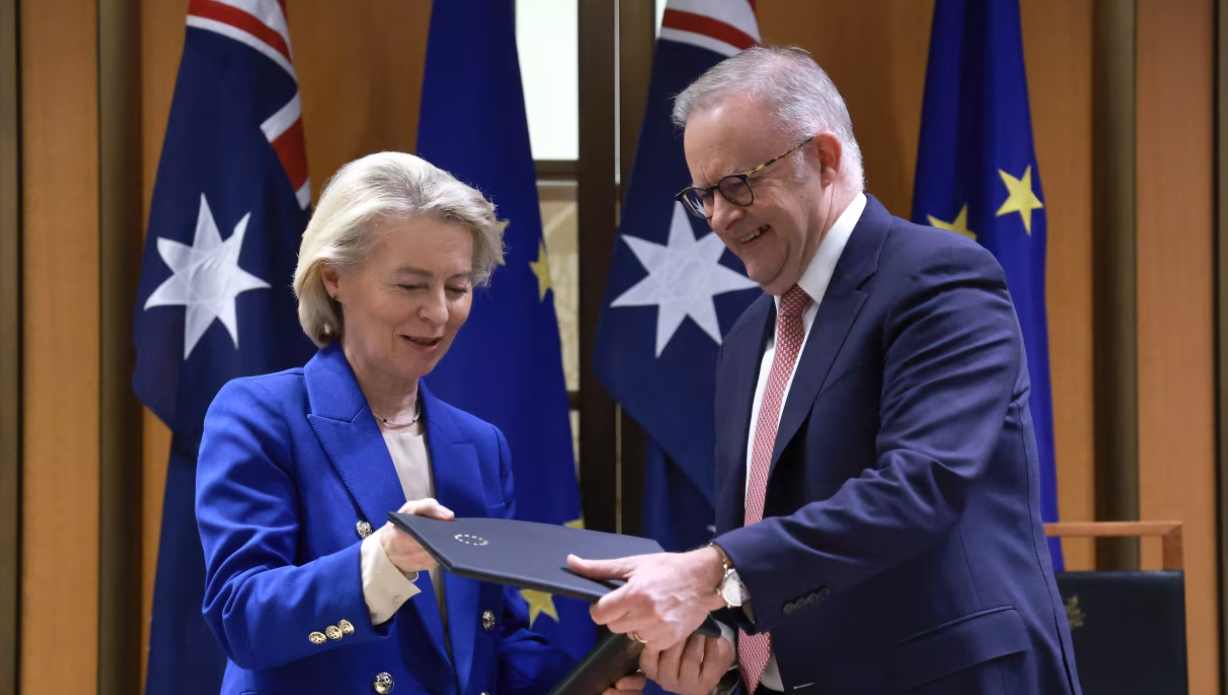
In March 2026, the European Union and Australia successfully agreed on the final text of a comprehensive free trade agreement in Melbourne. European Commission president Ursula von der Leyen and Australian Prime Minister Anthony Albanese signed the agreement at the Australian Parliament House, concluding prolonged negotiations that began in 2018. This economic advancement comes at a time when the EU and Australia seek to diversify trade relationships and reduce their dependence on China and exposure to unpredictable U.S. tariffs. Von der Leyen told reporters, “Today we are telling an important story to a world that is deeply changing. A world where great powers are using tariffs as leverage and supply chains as vulnerabilities to be exploited.” The agreement eliminates over 99% of tariffs on EU exports to Australia while expanding access to critical raw materials.
Australia produces large amounts of lithium, cobalt, manganese, hydrogen and other rare earth materials that are vital for Europe’s renewable energy technology, battery manufacturing and AI development. The deal will eliminate or reduce tariffs on them, building robust supply chains on both sides. This provision of the deal was vital, as skyrocketing global demand combined with China’s weaponization of the world’s dependence on its own rare earth minerals deemed it absolutely critical to find a stable source of such materials. The pact established environmental and safety standards to guarantee sustainable extraction.
The agreement also mandates enforceable commitments on social and environmental standards. Key measures include:
- Adherence to the ILO (International Labour Organization)
- Paris Climate Agreement enforcement
- Action against deforestation, illegal wildlife trade, and illegal fishing
- Requiring all imports from Australia to follow EU health and safety rules
Additionally, the deal includes safeguards to protect sensitive sectors in the EU. Import limits have been established on a variety of agricultural sectors—including beef, sheep and goat meat, rice, sugar and certain dairy products—to guarantee that Australian imports face zero or reduced tariffs in restricted amounts and under specific conditions. This ensures that external trade flows don’t undercut domestic industries. Additionally, a protective measure was established that lets the EU respond quickly if a rapid influx of Australian imports starts to hurt EU farmers.
The EU and Australia currently sustain solid commercial ties, trading over €89.2 billion ($103 billion) annually in goods and services. The agreement projects substantial EU economic growth: up to €1 billion ($1.15 billion) in annual tariff savings for exporters, a 33% increase in annual exports over the next decade, and a €4 billion ($4.6 billion) GDP boost by 2030. According to EU modelling, Australia’s real GDP could rise up to $7.8 billion by 2030.
The agreement represents the EU’s latest initiative to expand its influence in the strategic Indo-Pacific region, following its free trade negotiations concluded with Indonesia in September 2025 and with India in January 2026.
Read more here: