Finley Ballin — August 18, 2026
More than five years after the military coup, the Myanmar civil war offers a revealing example of modern warfare. The conflict has combined inexpensive drone technology, ethnic rebellion groups, pro-democracy resistance organizations, and airstrikes into a disastrous and brutal struggle for democracy and autonomy from a military junta. Behind the war sits a complicated history filled with power struggles, authoritarianism, and protests.
Background
The war stems from a military coup that took place on February 1st, 2021. Members of Myanmar’s ruling party, the National League for Democracy (NLD), were deposed by the Tatmadaw (Myanmar’s military). President Win Myint, State Counsellor Aung San Suu Kyi, and other notable members of the NLD were jailed and prosecuted on charges widely considered to be politically motivated. The acting president then declared a state of emergency, transferring power to the Commander-in-Chief and allowing the Tatmadaw to hold total control of the government. The uproar was immediate, sending armed insurgencies and the exiled National Unity Government (NUG) into a direct conflict with the Tatmadaw.
Conflict is not new to Myanmar. Throughout the nation’s history, the military has held a tight grip over the administration. After gaining independence from Britain in 1948, the nation suffered from severe fragmentation due to many strained ethnic insurgencies and communist rebellions. Within the next decade, the military took a higher administrative role within the civilian government. Then, in 1962, General Ne Win led a military coup, suspending the constitution and launching a one-party socialist dictatorship that isolated the nation for 26 years.
Ne Win’s administration began to crumble due to many controversial decisions. In September of 1987, nearly 80% of all currency used in Myanmar was declared worthless, and a new currency was announced. The state’s mismanagement of the economy had led to overwhelming national poverty and starvation. That year, the UN declared Myanmar a “least developed country” (LDCs). With central government power waning, protestors began to speak out against the government. Pro-democracy protests taking place in 1988 were violently suppressed by the military. Thousands died, and many were jailed in prisons with unhealthy conditions. Despite an intense crackdown on demonstrations, Ne Win resigned from his position, being replaced by a successor declared the “Butcher of Rangoon.” Soldiers shot doctors and nurses treating wounded civilians during his short duration as acting president, representing a lack of withdrawal from brute force. His administration lasted only 17 days, where administrative organizations then collapsed. Nearly one million people had gathered at Shwedagon Pagoda in Rangoon (now called Yangon) to protest the military rule of Myanmar, calling for a multiparty democratic government.
Sensing a loss of power and centralization, General Saw Maung staged an internal coup and fought against internal protestors. His administration repealed a constitution implemented under Ne Win, imposing martial law and indiscriminately firing on protestors. Those arrested were subject to torture in prisons, enduring harsh conditions and unsanitary food. Interrogation centers utilized hot iron rods, canes, electrical shocks, and burning. Prisoners were made to sleep on concrete floors in unsafe conditions. Many members of the opposition died without receiving proper medical care.
After that year, the State Law and Order Restoration Council (SLORC) promised multi-party elections to restore legitimacy to the government. The NLD was formed under the ideal of democracy and a restored constitution. The administration allowed an election to occur, in which the NLD won nearly 80% of the government seats available. The military immediately refused to hand over power to the NLD, stating that the NLD were only there to help write a constitution, not form a government. Members of the opposition were later detained or exiled, including Aung San Suu Kyi.
Later reforms led to NLD members being freed from prison and elections being opened, though the military still maintained a significant amount of control over the system. Included in the constitution were several provisions to give the unelected military a significant influence over politics, though elected members still could participate. This system was protested against by the NLD, where they abstained from the first election due to the system’s lack of real democratic reform. Their strategy later changed, seeking to change policy and employ further democratic reforms.
Now, five and a half years later, the war seems to have entered a deadlock in which all parties are struggling to make progress on their objectives. Resistance forces maintain control of significant rural and border territories, while the central government has defended its claim over major cities and industries.
International Affairs
International organizations have produced very little to show for their peace-brokering efforts. While the Association of Southeast Asian Nations (ASEAN) has produced meaningful aid contributions to civilians impacted by the war, diplomatic talks have been restricted to targeted envoys and private meetings between each side of the conflict. No direct talks between the NUG and the Tatmadaw have taken place, though ASEAN has held discussions between the many different groups involved in the civil war.
ASEAN’s involvement in the conflict has also been a point of contention between the NUG and the Tatmadaw. The NUG issued a statement condemning interaction with the junta government, stating that it risks legitimizing an authoritarian and illegitimate regime. This has been echoed by other humanitarian groups, still tackling the issue of the Rohingya genocide committed by the Tatmadaw a decade ago. The Tatmadaw had previously declared the NUG a terrorist organization, and also condemned interaction with their enemy.
While the war has not received as much international attention as other world conflicts, the UN has not been silent about it. Records exist of numerous trespasses on human rights, politically charged detentions, and crimes against humanity in warfare. In the months following the coup, peaceful civilian demonstrations were violently suppressed by state police and military forces, resulting in demonstrators being shot, killed, beaten, and arrested. The Independent Investigative Mechanism for Myanmar (IIMM) confirmed reports of airstrikes on civilian infrastructure, including hospitals, homes, and schools. A humanitarian update from the Office for the Coordination of Humanitarian Affairs (OCHA) states that over 16 million individuals are in need in Myanmar, and nearly 3.8 million are displaced.
Foreign nations have taken their own stake in Myanmar’s civil war, utilizing the conflict as a way to advance their own interests. One stark example is China’s involvement within the region, in which the nation has engaged with the Tatmadaw-backed de facto leader since the coup, hosting diplomatic missions and utilizing its veto power in the UN to support the junta’s interests. China’s support is not constrained to the junta, though. China has repeatedly denied claims of funding internal rebel groups within Myanmar, but has approved non-state decisions that support Chinese interests. China approved a plan from the Three Brotherhood Alliance (a coalition of three large rebel groups), to stomp out online scams and junta-supporting cyber-crime syndicates within Myanmar. The operation later led to the capture of many towns and strategic bases, further establishing rebel groups as a threat to the Tatmadaw.
India has also had its share of exchanges with the different forces at play in the Myanmar Civil War. The nation has acted mostly reserved, focusing on border security and trade. It has continued to have diplomatic relations with the Tatmadaw, and some investigations reveal military support and exchange. For example, a UN report revealed that state-owned and private companies in India had given the junta around $51 million in arms and raw materials associated with weapons production. India is not alone in its military support for the junta, though, as other reports show that Russia, Singapore, and Thailand have engaged in military arms trade with Myanmar following the coup, totalling to around one billion dollars in value.
Major Armed Organizations
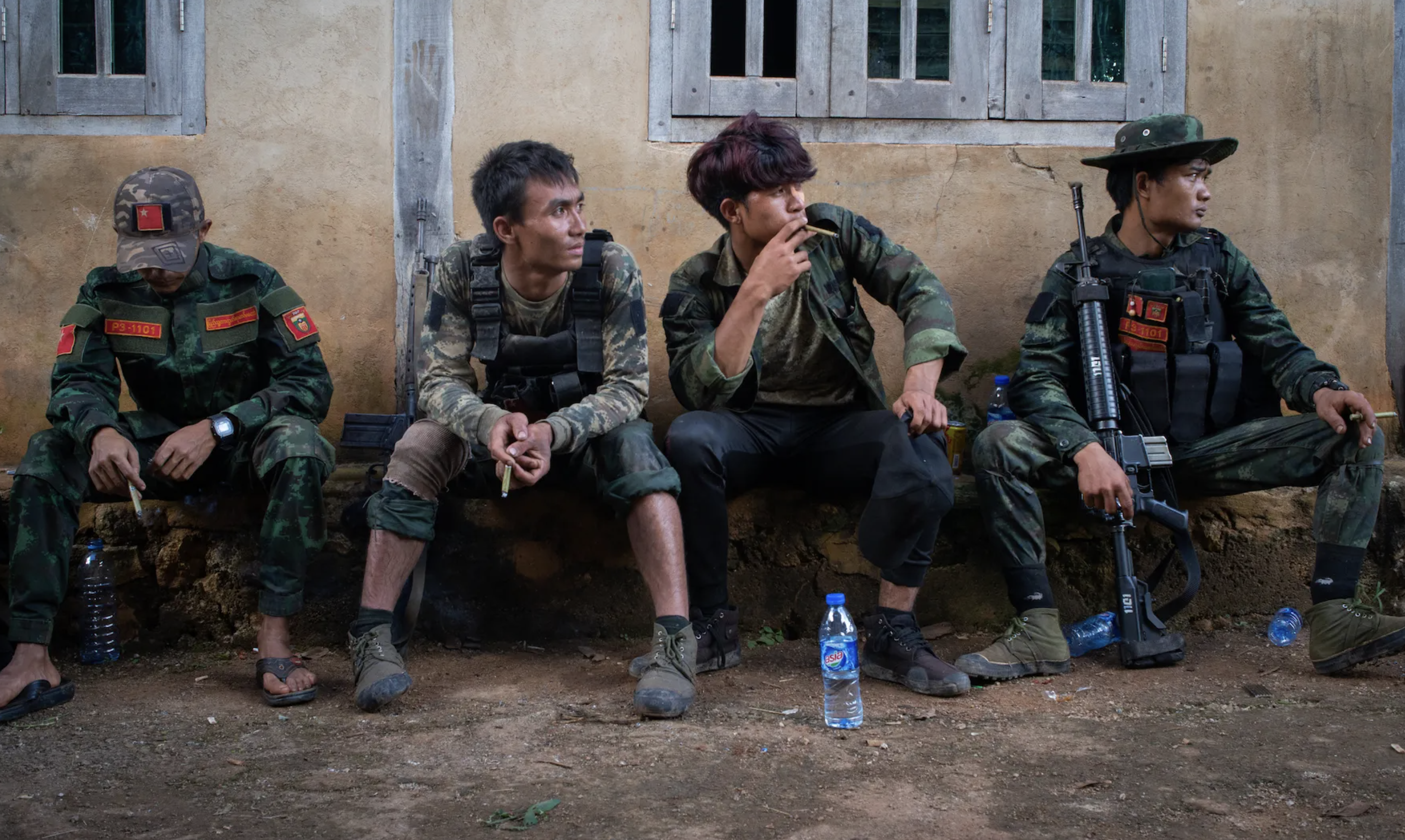
Obviously, with the range of names that have been brought up in this conflict, the war is not simply between the NUG and the Tatmadaw. Several different ethnic and political organizations are taking part in the conflict against the junta, or fighting to maintain their own stake of the nation. Some examples are:
The Kachin Independence Army. Established in 1961 as a military wing of the Kachin Independence Organization, this group is aligned for the self-determination of the Kachin people in Northern Myanmar, where several different Kachin tribes reside. While they predominantly operate within the Kachin State of Myanmar, the group extends into Yunnan, China, Northeast India, and the Shan State of Myanmar.
The United Wa State Army. The UWSA was established in 1989 after ethnic Wa soldiers separated from the central Communist Party of Burma. It is now in almost total control of the Wa region of Myanmar, and is considered Myanmar’s strongest and largest ethnic armed organization. While it has not aligned itself with the NUG, it is focused on its own territorial autonomy and diplomatic ties with China.
The Karen National Union and Karen National Liberation Army. Founded in 1949, a year after the independence of Myanmar from Britain, the KNLA has had a very tense relationship with the Burmese majority of the nation. The intensity of this relationship comes from the very beginning of the nation, where an ethnically Karen leader of the Myanmar military (the first Commander-in-Chief in the nation’s history), was arrested and replaced with Burmese nationalist Ne Win, his first role within Burma’s government. This is the same Ne Win that would go on to stage a coup of the government and remain dictator for 26 years. Since then, the KNLA has remained a combatant against the Tatmadaw, even in the years prior to the 2021 coup.
The Three Brotherhood Alliance. Consisting of the Arakan Army, the Myanmar National Democratic Alliance Army, and the Ta’ang National Liberation Army, this alliance rose in the wake of the 2021 coup, gaining immense support and formalizing its military structure. While the Arakan Army had been active prior to the coup, the alliance was reinvigorated by the junta’s actions in the Rohingya genocide and prosecutions of protestors. It retains a large territorial claim of Myanmar, though is challenged by pro-junta forces within the cities surrounded by TBA territory.
The Chin Brotherhood. The Chin Brotherhood unifies several ethnic armed groups into one organization. They formed after the Myanmar Civil War, unlike most other combatant organizations involved in the conflict. Infighting has been common between the CB and some other small ethnic groups near the state, all sides striving for control of the smaller region of the nation.
Technology and Military Strategy
Drone technology has emerged as one of the war’s most important military developments. Typical rebel groups entered the conflict with little to no access to fighter planes or conventional artillery technology. With lessons learned from the conflict in Ukraine, commercial drones have been converted into disposable suicide explosive devices, allowing rebel groups and the Tatmadaw to fight remotely. This has forced both sides of the war to improvise drone countermeasures and change strategies. More consequentially, the use of drone warfare has resulted in the deaths of many civilians and strikes on non-combatant buildings. Myanmar now stands third in drone combat incidents recorded by ACLED, just behind Ukraine and Russia.
The Tatmadaw has maintained total air superiority, though has been challenged by rebel groups utilizing handheld air defense systems. According to Janes, a combat analyst organization, footage shows rebel groups within Myanmar firing a Chinese-made man-portable air-defence system (MANPADS) and successfully damaging a MAF (Myanmar Air Force) K-8 Karakorum light fighter jet. Instances like this signify a shift in military technology in favor of rebel groups, though supply of these systems remains limited. Rebel groups are significantly limited on what arms they can produce within their territories. Some of the most advanced groups only produce small arms and ammunition, while the Tatmadaw are able to produce large weaponry and military vehicles at a reliable pace.
This reliance on trade has led rebel groups to raid Tatmadaw camps just for their ammunition and supplies, mirroring tactics of classic guerrilla movements worldwide. Most notably, this strategy was prevalent in the Viet Cong, who utilized captured government outposts and stolen enemy arms to successfully fend off stronger opponents. As the Tatmadaw and large rebel groups utilize the same range of ammunition and weaponry, NUG forces and other ethnic insurgencies have been routinely replenished by enemy stockpiles and convoys.
The conflict in Myanmar is defining what modern guerrilla warfare looks like against a much more powerful state on a scale unseen before. Previous civil wars took place before the age of the drone or the advanced targeting system, so the impact on local communities and families is unprecedented. Myanmar still faces numerous humanitarian crises, strained by government authoritarianism, environmental disaster, and national fragmentation. Pro-democracy resistance has not faltered to the junta, and many still share hope for a Myanmar with a guaranteed democratic system, fair for all participants and free from military domination.
Read more here: