Maqbool Ibrahim — November 3, 2026
Serbian President Aleksander Vucic conceded defeat to the Student’s List on Sunday. This comes after nationwide snap elections which saw the president’s nationalist party, the Serbian Progressive Party (SNS) lose their majority in Serbian Parliament (104 compared to the Student List’s 140 out of 250). Millions of Serbs took to the streets this week, celebrating nearly two years of protesting against the Balkan government. One which, as critics argued, was increasingly falling into authoritarianism.
The catalyst for the protests, and by extension the elections, was the Novi Sad tragedy. Where, in 2024, a train station collapsed killing 16 people. Amongst dust and rubble, Novi Sad became the rallying cry for thousands of protestors in Belgrade. It symbolized the root of the problem plaguing their country: corruption.
Novi Sad is the best example of Serbian corruption under Vucic. When the train station was being renovated, tenders were allocated based on political loyalty and cronyism rather than competence. Ignored safety standards and attempts to shield politicians from accountability led to numerous tragedies like Novi Sad, striking at the very base of Serbian democracy.
However, Novi Sad was just one example of a much wider trend of corruption in Serbia. Vucic had gained a near-total monopoly on public and private broadcasters (such as RTS). With these, he blanketed the Serbian information sector with pro-government propaganda, vilifying his opponents. Independents had it even worse. Vucic’s control of major news networks meant independents faced significant tax cuts, penalties and public smear campaigns, ending their campaigns before they started.
Furthermore, Vucic subordinated state institutions to the interests of the SNS. By placing people loyal to him at every level of government (the judiciary, legislative, executive) he effectively ended classical checks and balances.
But for the common person, corruption didn’t manifest in a complete, systemic takeover of Serbian politics. For millions of Slavic people, bribery and corruption were essentially the norm of life in the Balkan country; shady legislative dealings in courts, unreliable paperwork in critical industries, meant people completely lost faith in their government.
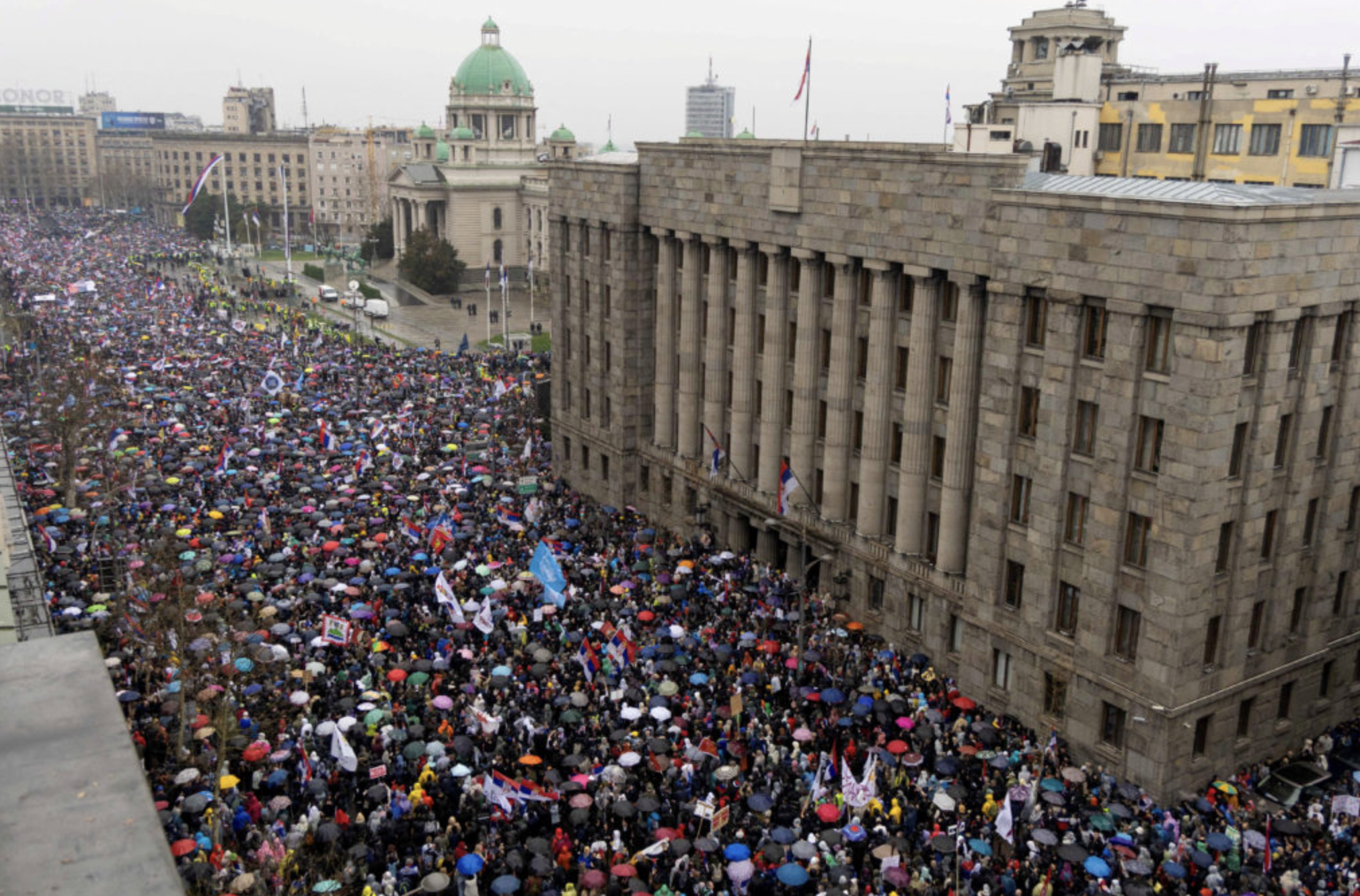
More than 500,000 protestors flooded the streets of Serbia. People walked hundreds of kilometers, cycled thousands of miles to raise international and domestic awareness. And on election day, nearly 180,000 trained and organized people acted as watchdogs to prevent electoral fraud.
Two years of pressure and protests came to a head last week. On October 25th, 2026, in response to the intense public pressure, President Vucic announced emergency snap elections, hoping to reinforce his control over Serbian politics.
Serbia acts as one electoral district, instead of individual constituencies. On election day, voters cast a ballot for a political party, coalition or a citizen’s list instead of individual politicians. Leading up to the snap election, opposition leaders willingly forfeited their campaigns. Student Lists members used nationalist rhetoric, calling out the “corrupted” government, in an effort to make the election a simple choice: the government or the youth.
And the ballots show it worked. In a historic upset, the newly formed Student’s List gained an absolute majority in the Serbian parliament (winning 141 seats) beating President Vucic’s SNS. On Sunday, Vucic officially conceded defeat in a televised national address, stating: “It is clear we have lost these elections.” Ending his 14 year old reign in office.
To be clear, the elections in Serbia were much more nuanced than a black and white ballot. While people like Nina Dordevic lamented the SNS as a “big evil” Serbs needed to rip out, hundreds of Serbians did vote for Vucic, and many people didn’t agree with the Student’s List either. Elderly citizens, such as one interviewed by the New York Times, said that they were “scared of all the protests” and were wary of the Student’s List.
This election is a turning point in Serbian politics. For the Student’s List, it creates the crucial problem of transitioning from a grassroots protest movement to a formal government. Change will be slow in Serbia, as the government chips away at the 14 year old institution of power Vucic had created. The country will transition into a critical period of uncertainty, as they battle internal and international pressures to create a new government.
23-year old design student, Katarina Malesevic perfectly surmises the sentiment in the Balkan nation. “Today, I think, we have finally found freedom.” She said, “you can feel it everywhere in Belgrade, at last, there is peace… and you can feel the air is different. Everything smells of freedom.”
Read More Here: