Finian Knepper — March 17, 2026
On January 29th, US President Donald Trump signed executive order 14380: “Addressing Threats to the United States by the Government of Cuba.” The executive order declares a state of emergency in the United States, declaring Cuba an extraordinary and unusual threat to the United States that requires immediate action and response. It alleges that Cuba has been receiving funding from China, Russia, Iran, Hezbollah, and Hamas, and has in turn allowed for a buildup of said actors’ military presence on the island. The executive order additionally alleges that Cuba has been funding and supplying terrorism, cartels, and the drug trade into America. Cuban human rights abuses and political persecutions are also listed.
In tandem with these accusations, Executive Order 14380 places a complete naval blockade on all imports of oil to Cuba, completely starving the island of a major source of power and resources. Tariffs on other nations that attempt to import oil into Cuba, most often Mexico and Russia. The US operation “Just Cause” that captured Venezuelan president Nicolas Maduro led to his replacement with interim president Delcy Rodríguez, the former vice president. President Rodríguez has adopted a much more pro-US stance and has complied with Trump in the blockage of oil to Cuba.
Four weeks later, the results have been devastating. Up to 80% of Cuba’s power is produced by oil, both domestic and foreign, but it relies on imported energy for 95% of its annual power costs. Cuba’s power grid is also many decades out of date, with power lines and generation facilities sometimes more than 40 years old. Decades of lack of maintenance and underinvestment have left Cuba’s energy grid to crumble, making a shortage of oil make blackouts even more devastating. Additionally, Cuba has virtually no oil reserves, with enough to last the nation no more than a few weeks at most.
This has led to some devastating humanitarian consequences. Gasoline has had to be rationed, and food has had to be used up. Hundreds of products have been spoiled. William Leogrande, a professor at American University who has tracked Cuba for years, said: “it would be constant misery for the general population, and eventually, the economy could collapse just completely, and then you would have social chaos and probably mass migration.”
Frequent blackouts have hit the country, some lasting more than 18 hours each. And on March 16th, Cuba suffered its first nationwide blackout in decades, with nearly 11 million stuck without power in a deepening crisis. This includes hospitals, schools, and military sites. It is estimated that 96,000 surgeries have been postponed as a result of the blockades. While no deaths have been officially reported as a result of blackouts, the humanitarian impact has been undeniable.
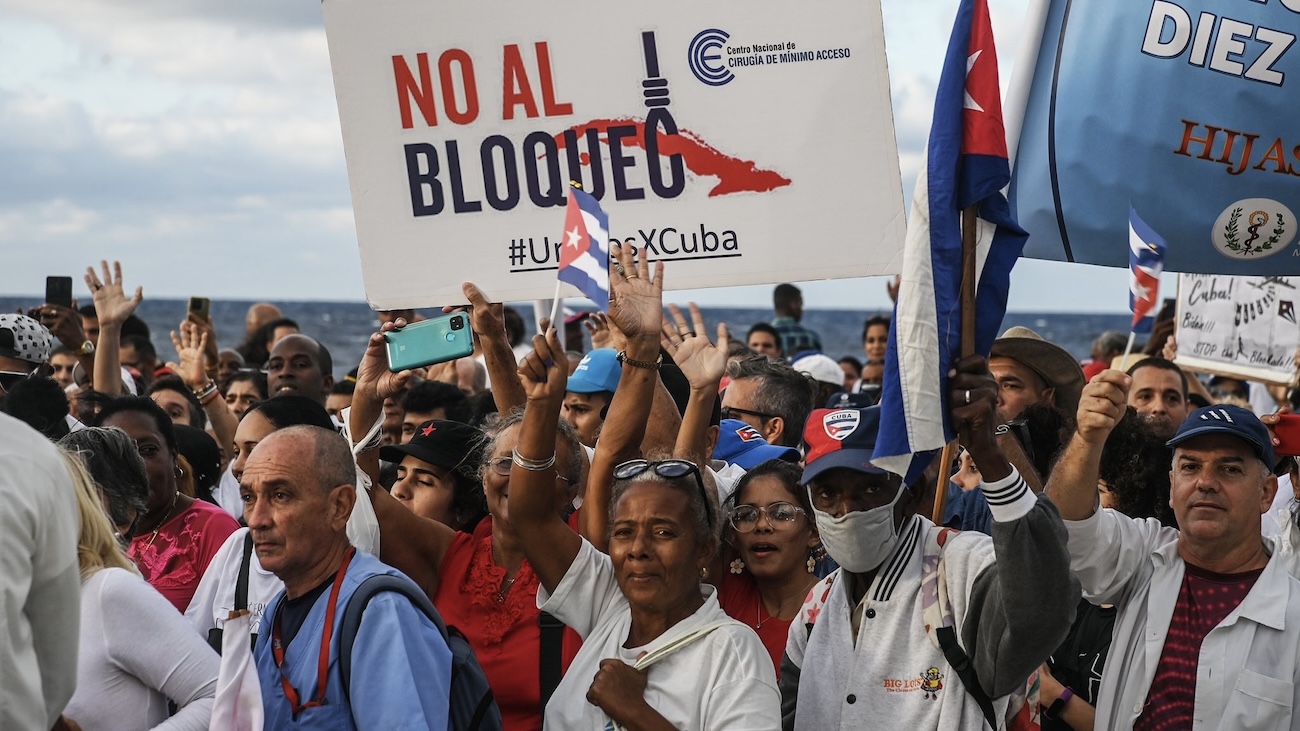
The shortages and restrictions on purchases have led to protests around the nation. Authorities said on Saturday that five people were arrested amid what the government called “vandalism acts” in the city of Morón. Unverified videos of the incident show protesters breaking into the office and throwing stones at a burning building. According to Reuters, shouts of “liberty” could be heard in one of the videos.
Cuba’s government, as of March 13th, has reached out to the US for diplomatic talks to end the crisis. However, Trump vowed to “take” Cuba on March 16th—raising the possibility that the window for diplomacy may have been closed, if it was ever open to begin with.
In total, the Cuban blockade has led to a major economic crisis on the island, which, combined with blackouts around the nation, is leading to a worsening economic crisis by the day. As blackouts continue, it becomes uncertain what the future of Cuba may be.
Read more here: