
Brogan Jones — May 5, 2026
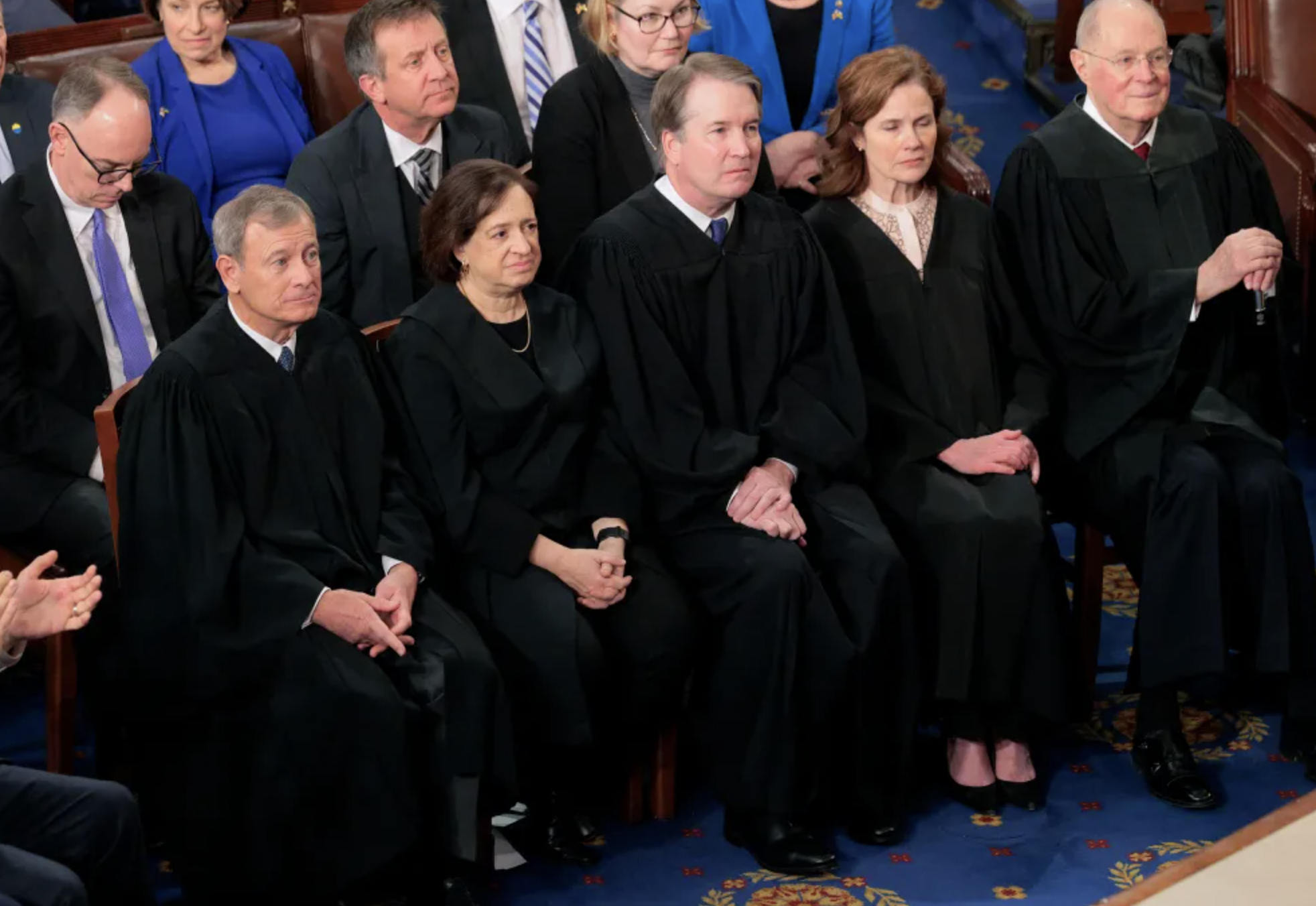
Over the last several years, the Supreme Court has handed down a multitude of controversial, landmark decisions. Most of these have been made along partisan lines, issued by the Court’s 6-3 conservative majority. The most recent example came on Wednesday, when the Court struck down Louisiana’s Congressional map as an unconstitutional racial gerrymander.
The case concerned Section 2 of the Voting Rights Act, a monumental piece of legislation signed into law by President Lyndon B. Johnson in 1965. Section 2 was originally included in the VRA to address racial vote dilution, a tactic commonly used to reduce the power of Black voters in the South during the Jim Crow era. The provision specifically bars voting maps that give a racial minority less opportunity than other members of the electorate to be adequately represented in political outcomes. This specific protection has managed to survive other VRA rollbacks and is considered today to be one of the most crucial protections against racial disenfranchisement. Section 2 has also served as the primary foundation for legal challenges lodged against discriminatory voting practices for decades.
Despite its role as a long-standing legal precedent, the Supreme Court gutted Section 2 on Wednesday when it made its ruling in Louisiana v. Callais, the case at the center of all of this. However, to understand this case, it’s important to examine an earlier one: Robinson v. Landry. This case challenged Louisiana’s former Congressional map, which grouped both New Orleans and Baton Rouge (Louisiana’s predominantly Black cities) into a single district, diminishing the representation of the state’s Black voters.
Under the former map, only one out of six Congressional districts was majority-Black, despite the fact that one-third of Louisiana’s entire population is Black. In January of 2024, Robinson v. Landry decided that this was unconstitutional and violated Section 2 of the VRA by diminishing the voting power of Black Louisianans. In response, the Louisiana state legislature put forward Senate Bill 8, which created a second majority-Black district to directly reflect the state’s Black population in Congress.
This brings us to Louisiana v. Callais, in which a group of “non-African American” voters known collectively as Callais challenged the 2024 redistricting for its use of race as a determining factor. On April 29, the Supreme Court officially sided with the Callais voters in a 6-3 decision. Justice Samuel Alito, who was in the 6-3 majority, claimed that the state’s interpretation of Section 2, and subsequent creation of a second majority-Black district, counterintuitively constituted race-based discrimination. The Court’s six conservative justices largely concurred that the redistricting was unconstitutional because it was based on race.
The Court’s ruling has immense political significance ahead of the 2026 midterms. Over the last several months, Democrats and Republicans alike have engaged in a redistricting battle to favor their party in November. The decision in Louisiana v. Callais is almost certain to give Republicans a leg up. Section 2 lawsuits have served as checks against partisan gerrymandering in the past. Compliance with the Voting Rights Act has prevented Southern Republicans from severely limiting the representation of Democrats, as such maps would typically also limit the representation of racial minorities. After the Supreme Court’s decision on Wednesday, however, there is little stopping states like Florida and Alabama from diminishing the number of minority and, subsequently, Democratic districts.
Read more here:
Extemp Question: What impact will the Supreme Court’s decision in Louisiana v. Callais have on the 2026 midterm elections?
Extemp Analysis by Brogan Jones
AGD/Background: I think your AGD and background information could go hand-in-hand with this one. I think starting with something more serious that emphasizes the importance of Section 2 would be your best bet (i.e. emphasizing the history of racial discrimination that Black Americans have faced at the ballot box). Then, I think you should explain what Section 2 is and briefly go through what Louisiana v. Callais was about without getting into all of the intricate details too much.
Answer/SOS: If I got this question, my answer would be that the Court’s decision will increase the likelihood of a Republican win in the midterms for three key reasons… 1) The vote allows southern Republicans to crowd out minority representation, 2) Minorities disproportionately vote blue, 3) The midterms will be decided by a small number of votes.
The first point is probably going to be the bulkiest. It can flow directly from the background information, and you can talk more about the specific ways in which the Court’s decision will prevent legal challenges to maps that are gerrymandered to exclude minority voters.
The second point goes hand-in-hand with the first and is fairly straightforward. You can just read off statistics which support that minority voters are more likely to vote Democratic, especially Black voters. This explains why cases about racial redistricting are politically significant, since Republicans diminishing the representation of Black voters most likely means they will also diminish the representation of Democrats in Congress.
The third point is simply that the midterms are an extremely tight race, which is why both sides are attempting to redistrict states to favor their party in the midterms. This means that any leg up Republicans can get will be extremely advantageous. Thus, the Court’s decision could move the needle in their favor, possibly contributing to a Republican win come November.