Dhruv Arun — July 14, 2026
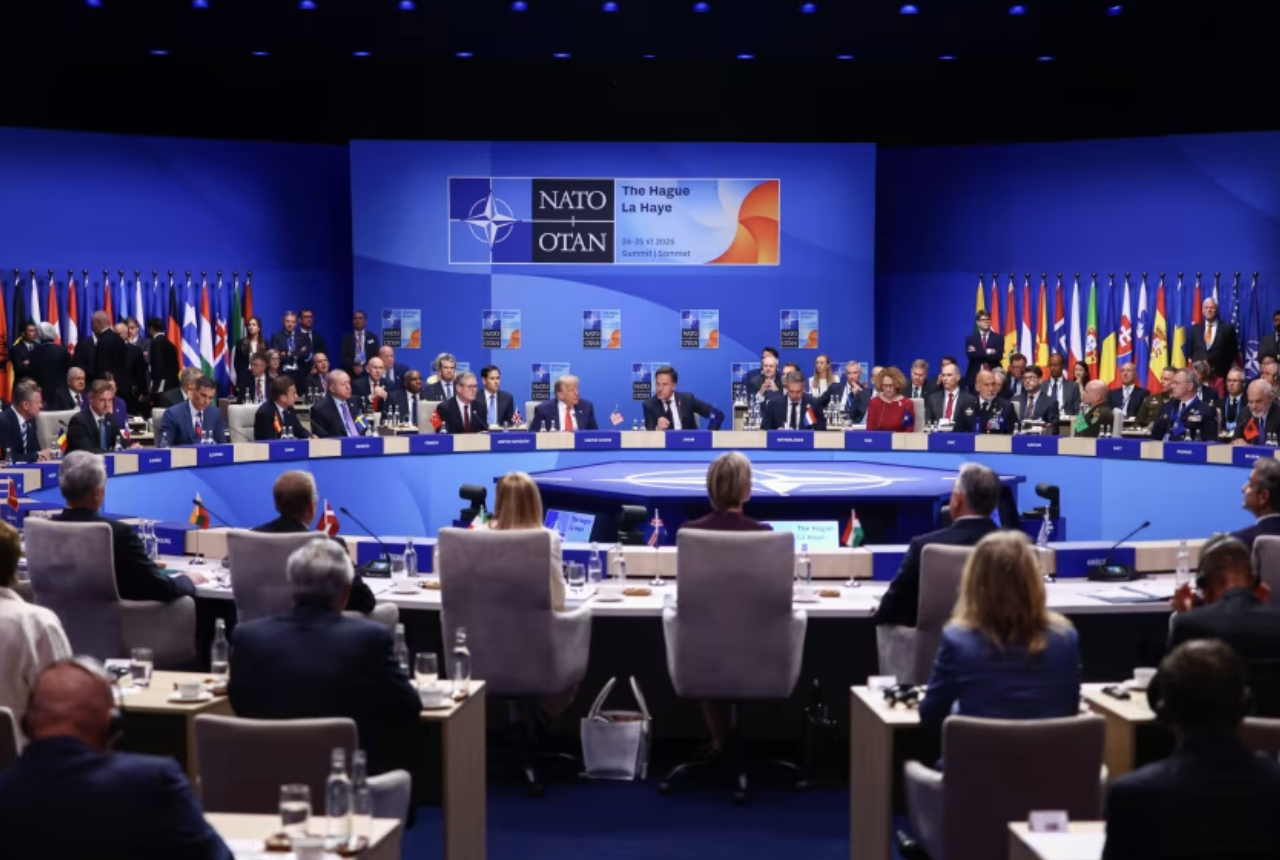
For the last eighty years, Europe’s security has rested and depended on American leadership. The United States supplied the alliance’s military strength, nuclear deterrents, and strategic command. Many European governments, in return, devoted fewer resources to defense and focused more heavily on domestic priorities. That balance is beginning to change. The shift has accelerated under President Donald J. Trump, who has repeatedly argued that European allies should take and assume a far greater share of the burden for their own defense & protection. At NATO’s summit at The Hague in 2025, alliance members promised to raise their long-term defense and security spending target to 5 percent of GDP by 2035, more than doubling the previous benchmark. One year later, leaders gathered in Ankara with detailed plans explaining how they would intend to meet those commitments.
The discussion extends way beyond larger defense budgets. Europe is also reconsidering who should command military operations, where weapons should be produced, and who will carry the responsibility if this deterrence fails. These changes are unfolding across three connected areas: military leadership, financial investment, and industrial production. Together, they are fundamentally reshaping the fragmented relationship between Europe and the United States and raising new questions about how NATO will operate in the future.
Background
Recent NATO data shows how quickly defense priorities have shifted. Five member states are already expected to exceed the alliance’s brand new 3.5 percent core defense spending goal this year, despite the deadline remaining nearly a decade away. Lithuania currently leads at 5.33 percent of GDP, followed by Estonia at 5.1 percent, Latvia at 4.92 percent, Poland at 4.68 percent, and Greece at 3.65 percent. These countries all share one important characteristic. Most sit close to Russia’s borders and view the threat from Moscow as pretty immediate rather than theoretical. Their geographic position has further pushed them to expand defense spending faster than many of Western Europe’s larger economies.
The gap between everyone in NATO remains blaringly significant. Just a few years ago, Albania, Slovenia, and the Czech Republic had not yet met the alliance’s former 2 percent defense spending target. This year, all three of them are now projected to exceed that level, even though the alliance has already adopted much higher expectations. Additionally, Belgium currently sits at 2 percent, while Portugal and Italy spend slightly above that mark. Germany, France, and the United Kingdom all devote a way smaller percentage of their GDP to defense than several frontline states, although their larger economies still produce substantially higher total defense budgets overall. Across Europe and Canada, NATO expects average defense spending to reach about 2.53 percent of GDP this year. This shows meaningful progress that these countries are taking, yet the alliance still has considerable ground to cover before all of the members collectively reach the new 3.5 percent core defense goal and the broader 5 percent security target.
Much of that progress has come under continued pressure from President Trump, who has repeatedly argued that European allies should carry more of the burden instead of relying so heavily on the United States. NATO Secretary General Mark Rutte has echoed the need for stronger investment and assistance for Ukraine ahead of the Ankara summit. Rutte has also highlighted the progress that has already been made. Over the past decade, European allies and Canada have collectively added roughly $1.2 trillion in defense spending, and every NATO member now meets or exceeds the alliance’s previous 2 percent benchmark.
Even so, increased spending showcases greater commitment from these countries, but larger budgets alone do not automatically mean way stronger military capabilities. The central issue facing Europe is whether additional funding will translate into greater operational independence, or whether European forces will continue to depend on American planning, leadership, and strategic support.
What Europe Is Doing
Contemporary Europe’s response extends beyond increasing their military budgets. Governments across the continent are changing how NATO is led by different leaders, expanding defense spending to protect against threats, strengthening domestic weapons production, and preparing their own forces to assume greater responsibility in Europe. Together, these efforts represent one of the largest shifts in European defense policy since the Cold War.
In February of 2026, NATO reached an astonishing and historical milestone by placing European officers in charge of all three Joint Force Commands, the headquarters responsible for directing alliance operations during major crises. For the first time, Americans no longer led those positions. The transition, although impressive, still came with important limits. The United States still holds NATO’s highest military office and still continues to oversee the component commands that are responsible for operational planning, readiness, and force coordination. While European commanders now lead the alliance’s crisis headquarters, much of the day-to-day planning process remains under American supervision.
A multitude of defense analysts argue that this distinction matters so much more than the leadership titles themselves. They contend that military independence mainly depends on who develops strategy and directs operations, not simply who occupies senior positions. Under this interesting view, Europe gains little from spending more money if the alliance’s core planning structure continues to rely on American leadership.
Europe has also started taking responsibility for several specific regions. Sweden now commands a NATO force focused on monitoring Russian and Chinese activity in the Arctic. This move reflects a broader effort to place European nations in charge of missions tied directly to their own security interests and those of their allies instead of primarily supporting operations planned by the US.
Higher Defense Spending
The alliance’s brand new spending framework marks one of NATO’s largest policy changes in decades. Members agreed to dedicate 3.5 percent of GDP to core military spending and another 1.5 percent to broader security investments, such as cybersecurity and critical infrastructure. Together, these commitments produce the new 5 percent target. The decision primarily reflects growing concern over Russia’s war in Ukraine and a wider belief across Europe that long term American security guarantees should no longer be taken for granted.
At the Ankara summit, governments presented strategies explaining how they plan to meet these new commitments. Leaders also announced additional investments designed to expand Europe’s defense industry and increase military production over the coming decade.
Expanding Europe’s Defense Industry
European leaders recognize that if they want to have larger defense budgets, they have to invest in factories and supply chains that produce modern weapons. At a meeting in Kraków in February 2026, defense ministers from France, Germany, Italy, Poland, and the United Kingdom described the effort to strengthen Europe’s defense industry as one of the continent’s most significant military projects in decades. Several projects are already moving forward. The Poland defense minister called the initiative a historic breakthrough. France and Italy are jointly developing a brand new air defense system intended to reduce reliance on American Patriot batteries, with initial deployment expected in 2027. Germany is expanding its IRIS-T missile program by developing a longer range version after the current system demonstrated its effectiveness in Ukraine. The United Kingdom has accelerated production of inexpensive drones and counter drone technology, placing greater emphasis on rapid deployment than lengthy development cycles.
Privatized investment has also accelerated. A German defense technology company specializing in artificial intelligence raised $1.8 billion this year, reaching an estimated valuation of $18 billion. The investment ranks among the largest ever made in Europe’s defense technology sector. Unfortunately, with great progress comes great setbacks. A joint French German fighter aircraft program shockingly collapsed after disagreements over management responsibilities and technology sharing. The failure highlighted how difficult multinational defense projects remain, even among close allies.
Even though Europe is advancing, they continue to depend on American equipment in several critical areas. Germany, for example, is expanding domestic missile defense programs while simultaneously purchasing U.S. Tomahawk cruise missiles to fill immediate capability gaps. Chancellor Friedrich Merz described the acquisition as an important step toward closing a strategic weakness until European alternatives become available.
European governments are also preparing to replace portions of the conventional military presence the United States has begun reducing across the continent. NATO plans to expand its Response Force to roughly 300,000 troops, with European countries expected to provide so much of the additional manpower.
Whether these forces become fully operational remains uncertain, but it remains certain that this is a task that needs to be done. Previous NATO expansion plans have faced questions about readiness and deployment timelines. The success of this latest effort will play a major role in determining whether Europe can assume greater responsibility for its own defense.
The U.S. Reaction
The United States has welcomed Europe’s growing investment in defense, but American officials remain divided over how much responsibility should ultimately shift across the Atlantic. Some view Europe’s military buildup as a long overdue correction. Others question whether the alliance has changed in any meaningful way.
One clear sign of continued cooperation & support came during the Ankara summit. The United States and several European governments announced roughly $3 billion in new defense agreements as part of what officials described as a “NATO 3.0” initiative. The concept centers on Europe assuming a greater share of the defense burden while American companies continue supplying the equipment and technology in the meanwhile.
White House spokeswoman Anna Kelly pointed to the agreements as evidence that the summit benefited both sides. She noted that American defense companies secured more than $3 billion in contracts and joint ventures with allied governments. This goes to suggest that Europe’s military expansion is strengthening cooperation with U.S. industry rather than replacing it. A very similar example emerged through a partnership between Lockheed Martin and Germany’s Rheinmetall. Both of these companies agreed to jointly manufacture ATACMS missiles, increasing production inside Europe while maintaining close ties to American technology and defense firms.
The argument of increased or decreased defense priorities rests on Europe’s existing advantages. The continent’s combined economy is much larger than Russia’s. European industries already produce highly advanced machinery, pharmaceuticals, and electronics on a massive scale. Russia’s military has also deeply struggled to achieve decisive results against Ukraine despite holding significant numerical advantages and being 10X larger than Ukraine. Some people, though, are arguing that Europe has the resources, they’re just not levying it in the right way to defeat Russia.
Prior to this, the Congressional Research Service has offered a more measured assessment before the Ankara summit. The report noted continuing uncertainty among many allied governments. President Trump’s public criticism of NATO, his comments about acquiring Greenland, and plans to reduce portions of the U.S. military presence in Europe have raised questions about how strong America’s long term commitment will remain. Not every analyst believes Europe has fundamentally changed its position inside the alliance. Matthew MacKenzie, writing for Americans for Prosperity, argued that recent command appointments represent progress but stop short of true military independence. This essentially means that The United States still controls NATO’s highest military office and oversees the alliance’s operational planning structure. As a result, European commanders continue operating within a system largely directed by American leadership.
MacKenzie argues that defense spending by itself does not determine or allow for strategic independence. The more important issue is accountability. As long as European governments believe the United States will remain the alliance’s ultimate security guarantee, they face less pressure to accept the political and military risks associated with complete self-reliance. Additionally, this self-reliance in European militaries continues depending heavily on American equipment in several essential areas: including air and missile defense, long range precision weapons, satellite communications, and the command and surveillance systems required to coordinate modern military operations.
Germany illustrates this reality. While investing heavily in domestic missile programs, they continue to purchase American Tomahawk cruise missiles because European replacements remain years away from entering service.
Taken together, these developments represent that Europe’s military transformation is still a work in progress. The continent is expanding its own defense capabilities while continuing to rely on American technology and support in several critical areas. Rather than representing a complete transfer of responsibility, the current transition reflects a gradual process that will likely continue well into the next decade.
What This Transformation Means
Looking at each announcement by itself makes Europe’s defense buildup seem straightforward. Taken together, though, a more complicated picture emerges. Europe is not trying to replace the United States overnight. It is trying to become capable enough to defend itself without risking the kind of sudden American pullback that its militaries are not yet prepared to handle.
This balancing act explains many of the decisions made over the past year. European governments are investing in domestic missile programs while buying American Tomahawks at the same time. They are celebrating the European leadership of NATO’s Joint Force Commands while leaving the alliance’s most influential military positions in American hands. They are committing to defense budgets that would have seemed impossible only a few years ago, even though many of the systems those budgets will fund won’t be operational until the end of the decade.
The biggest question is no longer whether Europe will spend more. That debate is largely over. The bigger question is whether Europe is willing to accept everything that comes with greater independence.
Money is only one piece of their military power. Command authority matters. Industrial capacity matters. Political responsibility matters. A continent spending five percent of its GDP on defense still depends on the US if its military plans, intelligence networks, long-range strike capabilities, and strategic decision making continue flowing through American institutions. That is why the changes inside NATO deserve as much attention as the new spending targets. European-led Joint Force Commands, Sweden’s leadership in the Arctic, and plans for a larger European rapid reaction force all point toward a gradual shift in responsibility.
The answer will depend less on whether European governments will reach their spending goals and more on whether they are willing to trust their own institutions. Building weapons is difficult. Building command structures that leaders are willing to rely on during a crisis is an even harder task. If Europe ultimately accepts both the costs and the risks of directing its own defense, NATO’s balance of power will look very different by the middle of the next decade.
Read More Here: