Satvi Vijaykumar — July 28, 2026
Introduction
Calls for change have been echoing in the corridors of government buildings since the institutionalization of settlements. In recent years, however, several visible advancements have redefined the effectiveness of such protests. Generation Z, or Gen-Z, has become the prime demographic responsible. Gen-Z encompasses the demographic born from 1997-2012. Around the world, Gen-Z protesters are harnessing the powers associated with decentralized organization, symbolism, and social media to spark reform.
This special report will thoroughly examine several Gen-Z protests worldwide, from India to Madagascar and from Nepal to the Americas, and the mechanisms that allow for their success.
It must be noted that several recent youth protests have been rooted in nonviolent philosophies. Research suggests that nonviolent protests are effective 53% of the time, compared to a mere 26% for violent movements. Gen-Z protests in India, Nepal, Africa, and the Americas have generally begun with nonviolent intentions, with a few fringe factions deciding to use violence. Most reported deaths mentioned below have stemmed from government police intervention and the violence that follows.
India
The Reason
One apparent emerging pattern has been an increasing volume of voices heard from youth in developing nations. In May 2026, rumors of leaked examination papers (NEET) necessary for undergraduate admissions led to the formation of the self-proclaimed “Cockroach Janta Party (CJP).” Its website and social media operated under the motto: “A political party for the people the system forgot to count.”
Chief Justice of India’s Supreme Court Surya Kant unknowingly gave birth to this movement’s name when he referred to India’s unemployed youth population as “cockroaches.” These condescending remarks from the government — paired with the realization that leaked papers favor wealthier students in the admissions process — have added fuel to widespread discontent with the Indian parliament.
Even though several of these exams were rescheduled, long-lasting change has not yet been guaranteed by government policy. Prime Minister Modi and Education Minister Dharmendra Pradhan have faced calls for resignation due to their poor handling of the situation. Even regional leadership, like the State of Tamilnadu’s Chief Minister Joseph Vijay, have remained silent among calls for change.
The Response
The movement officially began as satirical social media tweets from Abhijeet Dipke, a United States graduate who was extremely dissatisfied with the Indian education system. It has since grown to more than a million Gen-Z activists. In a little less than a month, the protests turned from abstract digital frustration to physical protests.
In June 2026, CJP sat down in Delhi and pledged only to leave when Pradhan resigned from office. Following the teachings of nonviolent activist Mahatma Gandhi, education activist Sonam Wangchuk also refused to eat during the protest, only recently breaking his fast after 26 days. Even though these actions garnered the interest and attention of local news outlets, PM Modi chose to ignore them.
On Monday, July 20th, 2026, the CJP commenced their latest protest, with 50,000 camped outside the parliament building, despite the sweltering heat of Delhi, India’s capital. The crowd was filled with both friends and parents of those who committed suicide due to their inability to take a life-changing exam, as well as those who resonated with the CJP’s mission.
During the march, Indian police were dispatched, bearing batons and tear gas to disperse the crowds. In the violence, at least 7 have been confirmed dead so far, with over 300 others injured.
PM Modi relented to hold talks with a CJP spokesperson, where three actions were demanded, including that compensation be provided to the families that have lost a loved one due to the exam leaks, protestors should not be prosecuted, and that the education minister resign. On July 25th, 2026, all of the CJP’s demands were agreed to, including the resignation of Education Minister Pradhan.
While India is the most recent and noteworthy example of the powerful impact that Gen-Z protests can have, there have been several similar movements by youth activists in other countries in recent years.
Nepal
The Reason
A neighboring country was in a similar situation less than a year ago. On September 4th, 2025, the Nepal government banned 26 social media platforms throughout the country, prompting outrage from Gen-Z individuals over political corruption. In a time when 30% of people globally rely on social media platforms as their main source of news, banning them can mean banning several bias-free and independent sources from reaching the common citizen. However, tensions against the government had been building up prior, with almost 1,700 people leaving the country every day.
The Response
4 days later, on September 8th, 2025, several students hosted a peaceful protest with signs promoting the engagement of Gen-Z in political decisions. “Stop corruption, not social media,” was a common cry heard. Similar to India, police used tear gas and guns to try to suppress the crowd, killing at least 76 and injuring more than 2,000. Home Minister Ramesh Lekhak lifted the ban to prevent further violence.
Madagascar
The Reason
Among the unrest in South Asian countries including Nepal, Bangladesh, and Indonesia, the same generation was active in Africa. In Madagascar, electricity and water outages prompted thousands of protesters to demand change in a government they perceived as corrupt. In fact, only about 36% of Madagascar’s population had access to electricity last year. For perspective, about 92% of the world’s population has electricity access.
The protests lasted three weeks and began in Antananarivo, the capital. As it spread throughout the country, it began to reflect deeper structural issues like unemployment and GDP decline.
The Response
In clashes surrounding the protest, 22 people were confirmed dead and over 100 injured. On Monday, September 29th, 2025, President Andry Rajoelina fired his prime minister and other government officials he blamed for the outages. However, one of the protesters’ main demands was that Rajoelina should resign. When that demand was not appeased, unrest continued until parliament decided to impeach him and Rajoelina fled the country.
The United States of America
Unlike most protests in developing democracies, Gen-Z activism in the United States seems to be more focused on individual issues rather than broad challenges concerning factors already stable in developed countries, such as extreme economic inequality. Therefore, while Gen-Z seems to be taking South Asia and Africa by storm with their opinions, their involvement in the United States manifests differently.
In the recent stream of No Kings Protests that occurred to protest President Donald Trump’s administration, the median age of a protester was 67. In addition, Gen-Z had the lowest voter turnout in the 2024 United States Presidential Election. However, these issues are not because Gen-Z is not politically involved.
Scott Warren, co-author of research at Johns Hopkins University, finds data that shows that younger people in the U.S. are becoming “more cynical and frustrated” with the overall governmental system, rather than becoming more progressive or conservative. The same data shows that younger people are less likely to refer to opposite candidates using terms like “evil” that reveal deep-rooted biases. This means that protests grouped around being either Democratic or Republican have less appeal to the newer generations.
Due to this, Gen-Z protesters seem to be more statistically drawn to protests that focus on specific issues and values, rather than broad protests of a political party. 32% of the United States’ Gen-Z population engages in activism regularly, compared to only 24% of millennials. The main observable difference between youth protests in countries like Nepal and Madagascar and the more dispersed tension in the United States is that American Gen-Z activism tends to center on specific issues rather than broad anti-government movements.
Patterns & Advantages
Recent research by Harvard Kennedy School Professor and political scientist Erica Chenoweth found that nonviolent protests with high youth involvement are more than twice as likely to be successful. Further analysis reveals several patterns visible globally across recent Gen-Z protests that could help explain this finding.
- Decentralized Organization
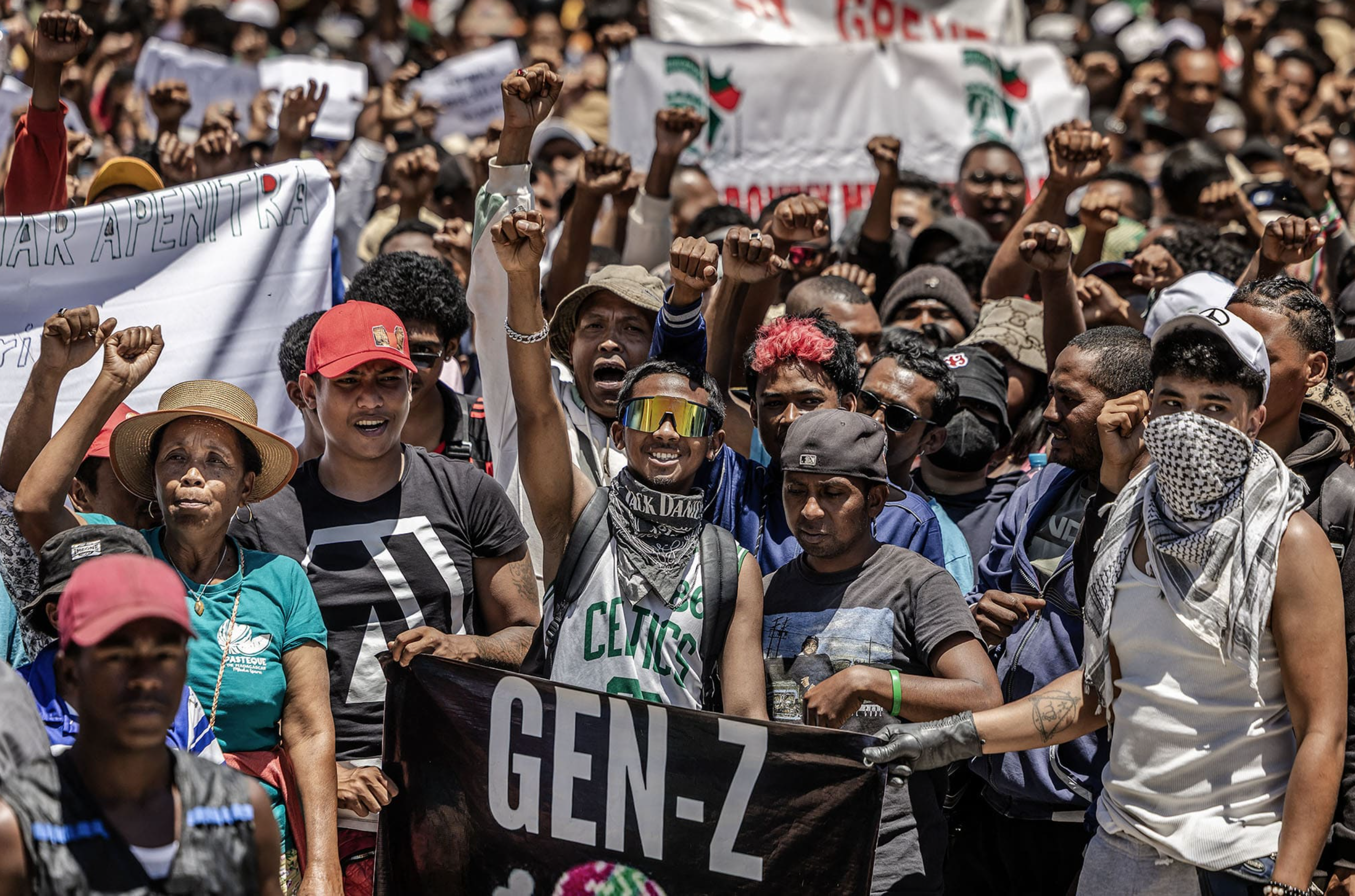
Gen-Z protests, such as those in Madagascar, tend to be decentralized, without a clear designated leader. Instead, they rely on autonomous local groups mobilized under the same cause. This makes it harder for existing regimes to repress them, since capturing a movement’s leader or one group is not enough to silence other smaller groups across the region.
- Pop Culture Symbolism
In all forms of politics, media, and marketing, symbolism is vital to spreading awareness of a cause. Visual symbols trigger emotions in the human brain as we begin to associate those symbols with meaning. For example, some No Kings demonstrations used references to symbols in pop culture like Star Wars to attract others based on the premise of the movie franchise itself.
However, there is one specific symbol being used on a larger scale. One Piece, a popular Japanese manga series, has become a symbol for change in Nepal, Madagascar, Indonesia, Peru, and many other countries. The manga revolves around themes of liberation and oppression, which are highly applicable to these protests. Gen-Z protesters in Asia have carried the Jolly Roger pirate flag to rally support for their respective causes.
- Single Issue to Systemic Reform
It is not uncommon that youth protests escalate into becoming focused on broader issues than they began as. This occurs as a result of built-up tension over several years or even decades of structural issues. In Madagascar, electricity outages became a catalyst for protesting long term corruption.
- Mobilizing using Social Media
A defining factor of several of these protests, especially the Indian CJP, is that they attract a wide audience using the power of social media. In fact, one American study finds that 66% of Gen-Z activism occurs online.
In India, the Cockroach Janta Party mobilized over 50,000 primarily via its social media reach; In about two months, the official account gained over 26 million followers on Instagram. They regularly post updates regarding progress spokespeople have had with the Indian government. In Kenya’s 2024 Gen-Z protests, short-form videos on TikTok became a way to garner like-minded youth to the cause. Kenyan news anchor Edith Kimani remarks that these short videos worked because they offer “digestible information” and help young activists find a sense of purpose.
According to Aditya Vashistha, assistant professor at Cornell University, social media’s role in amplifying protests helps explain why governments like Nepal have attempted to ban social media and restrict the possibility of anti-government rhetoric.
Limitations
While Gen-Z certainly has many benefits in the world of civil engagement, they are not immune to certain barriers that can increase as a result of their characteristics. Youth protests tend to face greater government repression than protests perpetrated by older citizens. This is likely because governments often see youth as more dangerous to people in positions of power. Additionally, if progress is made, the protesting group usually speaks with the government to articulate their demands. For the more decentralized Gen-Z protests, determining who will represent the movement as a spokesperson may be difficult. However, this is an issue that can be resolved with a faint structure. For example, the Indian CJP’s founder Abhijeet Dipke has appointed several spokespeople. And, of course, with any protest focused on overthrowing an autocratic or insufficient regime comes the chance that its replacement may not be any better. In the short-term, instability could make it difficult for the distribution of basic necessities, but the promise of a better future propels the youth regardless.
Conclusion
The newest social media “trend” has become the power of the young voice. With more than a threefold increase in social media users since 2012, its reach has been paired with passion to resolve persistent structural issues in governments worldwide. Across continents and language barriers, Generation Z has created a new rise of civil engagement and activism. Despite government backlash and intervention, crowds of youth have gathered in the streets of India, Nepal, Kenya, Bangladesh, Madagascar, and several other countries.
A testimony shared by a man who participated in Madagascar protests shares an inspiring thought behind his choice of activism: “Silence protects the oppressors, while visibility protects the people.”
Although such movements stem from varied issues, whether it be flaws in the education system or uneven access to reliable electricity, they reveal a key insight: modern global protests rarely focus on one issue. Rather, they stem from years of accumulated frustration with government corruption and systemic failures. Generation Z has harnessed that frustration and turned it into action, forcing governments worldwide to listen.
Read more:
- Amnesty International
- Andrew Lentini, Johns Hopkins University
- Erica Chenoweth, Why Gen-Z is Rising – Journal of Democracy
- Grace Segers, The New Republic
- Hannah Ellis-Petersen, The Guardian
- Human Rights Watch
- Kate Selker, Harvard Kennedy School
- Tripti Lahiri, Wall Street Journal
- Office of the High Commissioner for Human Rights, United Nations
- United Way NCA, The Gen Z Activism Survey