Rebecca Gehlmann — April 21, 2026
On Sunday, April 12, Victor Orban’s reign came crumbling down. The foremost far-right populist leader in Europe and hailed as a beacon of conservatism in the American MAGA movement, Orban has clung to power since 2010, making him Hungary’s longest-serving leader. During his long tenure, Orban dismantled Hungarian society in every direction. In 2012, at the start of his regime, Orban introduced a new constitution that allowed him to consolidate power. It shrank parliament, gerrymandered electoral districts to favor his Fidesz party, and eroded the powers of the nation’s Constitutional Court. Throughout his leadership, he would target the LGBTQ community under the guise of Christian nationalist ideology, crack down on freedom of the press, and distance Budapest from the rest of the European Union in favor of cultivating ties with Moscow.
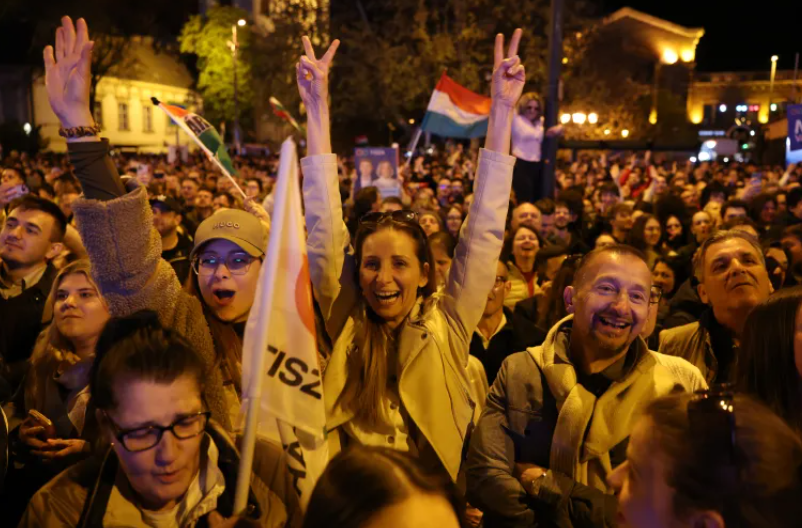
In this last election, Hungarian voters finally turned against Orban. They, however, did not swing to the opposite end of the political spectrum. Voters rallied around 45-year-old Peter Magyar, who had been a loyal member of the Orban government until February, 2024. Magyar broke from Fidesz as his party attempted to cover up a sexual abuse scandal and promised that while the current opposition was inept, reform would come from within Fidesz. He would spend the next months attacking Fidesz’s corruption and poor economic policy while uniting a diverse coalition with the simple slogan: “Now.” Clearly, this worked. His center-right Tisza party now commands a parliamentary supermajority.
One Tisza politician went viral for his jubilant dancing as his party sailed to victory, but it is perhaps too early to celebrate. It is debated whether Orban’s defeat truly represents the triumph of democracy over competitive authoritarianism or simply the result of failed Fidesz policies. Orban governed through fear-mongering, yet he lost his edge when countless threats never materialized. For example, he focused his most recent campaign on warning about foreign policy issues instead of addressing domestic concerns. Additionally, Fidesz’s long incumbency made it impossible for the party to divorce itself from Hungary’s economic woes. Tisza was able to capitalize on growing discontent over a stagnant economy and sticky inflation. Thus, it’s hard to say that Hungarians truly rejected Orban’s democratic backsliding, especially as they had previously backed him throughout his most anti-democratic reforms, as long as he provided a veneer of stability.
Regardless, Magyar now holds the power to unravel years of Orban’s destructive policy. The system Fidesz engineered to cling to power has given him a mandate for reform. But, it’s important to note that Magyar is no radical liberal. He tactfully avoided weighing in on culture-war topics like LGBTQ rights and stayed silent on the war in Ukraine throughout the election (although after winning, he has stated that he seeks to end the war and is less conciliatory towards Putin than his predecessor).
What is certain is that Magyar promises to return Hungary to a “normal, respected country” by delivering long-awaited reforms. Step one? Restore democratic checks and balances, likely by drafting a new constitution. This would include term limits for the prime minister, new electoral laws, restored judicial independence, and decentralization of government control of universities. Step two? Live up to his promise to stamp out corruption and institutional rot. Step three? Fix the scars that Orban has left on Hungarian society–the hardest step of all.
Orban’s regime has left hardly a single facet of Hungarian life untouched. His attacks on the free press left the nation’s media reduced to a propaganda machine distrusted by most citizens. Economically, Hungary is not only experiencing stagnation but also a dangerous reliance on Russian crude oil. In terms of foreign policy, Hungary will have to rebuild its fractured relationship with the European Union.
And these are only a sampling of the endless parts of Hungarian society that must recover from years of Orban’s rule. Magyar faces a herculean task, but he has the support of his people and the international community. It will be a rocky road forward, but for now, it seems that Hungary is taking the first steps.
Read more here: