Harry Xu — August 25, 2026
Peru has had no shortage of leaders in the past decade – since 2016, eight different presidents have cycled through office. In a country riddled with rampant crime and widespread corruption, political stability has struggled to remain afloat. Citizens, frustrated with the lack of change, have taken to the streets in intense protest. Still, turmoil prevails.
Earlier this year, voters headed to the ballots to elect their president for the next five years. After a competitive first round and weeks of counting, Keiko Fujimori emerged victorious, defeating her opponent in a runoff decided by less than 50,000 votes. The founder of the right-wing Popular Force party comes into power in a crucial time for Peru, where action is long overdue. This special report will examine the 2026 Peruvian election and its role in the tumultuous climate of the Latin American nation.
Background
Crime
In order to analyze the change needed, it is important to understand the conditions Peruvians face. Lately, crime rates in Peru have skyrocketed. Since the pandemic, where Peru had the highest death rate per capita, the country has experienced an influx of gangs — many of which migrated alongside refugees in the late 2010s. With the increase in crime, homicide rates and trafficking have become prevalent issues.
Extortion, where gangs force payments from civilians through threats of future violence, has become the norm; a report by the Observatory of Crime and Violence found a 29.3% increase in extortions in the first eight months of 2025 compared to 2024. The threat of violence is enough to compel most civilians to submit to gangs, who gain leverage through the money received.
Threats made to poorly-funded schools have led to fears in children’s education. Consequently, schools are shutting down as children learn virtually — many families cannot make the change, however. Public transportation, which many Peruvians are reliant on, has also been targeted. The same report found that 180 public transport drivers were murdered between January and August of last year. As a result, these workers have gone on strike numerous times in the capital city, Lima, to call for change. With education and transportation disrupted, civilians struggle to maintain their lifestyles. All the while, gangs hold unbridled control.
Corruption
Crime remains unchecked, as police forces are mired in corruption. Many policemen are being bribed in return for intel over upcoming raids. In small neighborhoods, law enforcement is sparse, with most officers patrolling wealthier districts. In rural regions, where illegal gold mining thrives, police presence is even lower. Inadequate police units are therefore unable to counter gangs in these crime hotspots.
Significant investigations are needed to reduce corruption, though funding for these units has been redirected by the government. While politicians could increase prosecutors’ power, the opposite has happened – in the past three years, Peru’s government has restricted the ability to regulate crime: for instance, they exempted political parties from criminal liability in 2024. With no oversight, crime and corruption only continue.
Protests
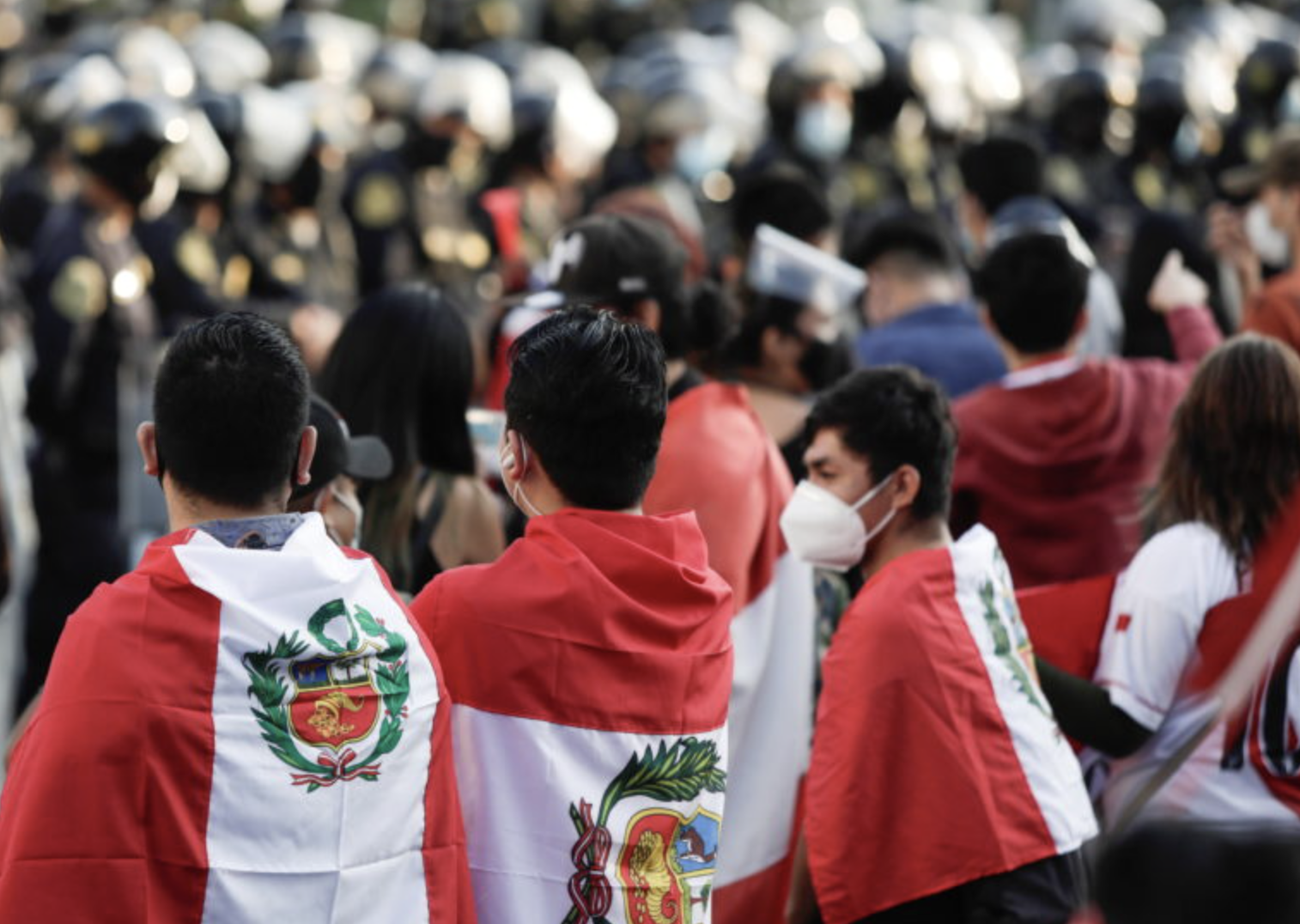
Protests against the unsafe conditions have become widespread. For example, in March of 2025, violence erupted in Lima following the killing of a celebrity. Dina Boluarte — the president at the time — declared a state of emergency, one of many during her tenure. Constitutional rights, including the right to assemble and protest, were suspended, and the military was deployed. Boluarte was later ousted from office, after lawmakers voted to impeach her due to “permanent moral incapacity.”
In October, José Jerí took office as Boluarte’s successor. He immediately faced demonstrators denouncing his past sexual allegations. After over 100 of them were injured, with one fatality, Jerí declared a state of emergency. Despite increasing demands, he refused to resign. Part of the Gen-Z protests (see Satvi’s report for more information), this movement highlighted the continued alienation between the president and the people.
Political Instability
It seems odd for Peru’s leaders to be overthrown in the blink of an eye; however, its constitution contains a clause which permits the ousting if the president is deemed “morally incapable.” Due to the lack of clarity, Peruvian lawmakers have interpreted the clause to justify the removals.
The frequent transition between leaders comes with less efficiency. Office-holders require time to select cabinet members and become acquainted, leading to less action. Cabinet members may also be replaced – former president Pedro Castillo appointed a whopping seven different Interior Ministers within thirteen months.
Economy
Despite the issues it faces, Peru has maintained a relatively strong economy. In 2025, the economy expanded by 3.5% due to high demand for the key exports of copper and gold. While the momentum gained in the past has dissipated, the country is still going strong, especially in comparison to nearby countries.
The backdrop of increasing crime has led citizens to become restless as reform fails to happen and leaders come and go. When the 2026 election approached – the first since 2021 – these topics were at the forefront of voters’ minds. It was paramount for voters to elect someone who could put a stop to the country’s turbulence.
The 2026 Election
The First Round
The first round of voting began on April 12th, with over 30 candidates on the presidential ballot. In Peru, if a candidate receives a majority of the votes, they will win; otherwise, the top two face off in a runoff. Voting is mandatory for citizens, one of 21 countries to enforce this rule. Thus, millions of citizens approached voting stations when Sunday came.
Many votes could not be cast – including more than 52,000 in Lima — due to faulty computers and missing ballot materials. As a result, Peruvian authorities extended voting to the 13th. Citizens expressed their dissatisfaction, since many missed out on a days’ worth of wages. At the same time, more than six million Peruvians opted to pay a fine in order to avoid voting. The distrust in the voting process was prevalent; many people waited hours in line, while many others did not exercise a constitutional right.
Peruvians also elected members of Congress during the election. This election cycle marked the return to a bicameral legislature, the first time since 1992 (a unicameral legislature was established when Alberto Fujimori – Peru’s president from 1990 to 2000 – attempted a self-coup and rewrote the constitution). Results from voting led to a divided Congress, with right-leaning parties holding similar numbers of seats as left-leaning and centrist parties.
On May 17th, Peru’s electoral board announced the two candidates for the runoff: Keiko Fujimori and Roberto Sánchez. Right-wing Fujimori received 17% of the votes, while left-wing Sánchez received 12%. With less than 30% of voters supporting the two candidates, the election remained in the air.
Keiko Fujimori
51-year-old Fujimori has experience in Peruvian politics, being the daughter of Alberto Fujimori. Her father’s actions have been divisive: he quelled a far-left group that had killed civilians for decades, while also forcibly sterilizing Indigenous populations. This culminated in a political scandal in which he fled to his parents’ country Japan. When attempting to come back, Alberto Fujiori was arrested. He was released in 2024 and died later that year.
When her parents divorced in 1994, Fujimori became the nation’s first lady at the age of 19. Her own political journey began in 2006, when she was elected as a congresswoman, garnering the highest number of votes in Peruvian history. Four years later, she founded Popular Force, a right-wing populist party.
Fujimori ran for president in the past three election cycles, reaching the runoffs each time and losing by a narrow margin to three different candidates. In the 2026 election, she promised to build prisons and deploy forces to fight crime, though many worried about the lack of focus on human rights. Additionally, she faced allegations of money laundering during her campaigns and was set to appear in court – however, the judge ultimately dismissed the trial after the aforementioned criminal liability law changed.
Fujimori is also the current leader of the Fujimorism movement, a fervent following of her father’s legacy. After he died, support for the movement grew, aiding her political career. Nevertheless, Fujimorism has not come without opposition. Anti-Fujimorism quickly emerged as an opposition movement – in fact, demonstrators spoke out this June against Fujimori’s runoff campaign.
Roberto Sánchez
57-year-old Sánchez has humble origins. Born in an Indigenous family, he had a Catholic upbringing that he has emphasized. In 2021, he was elected as a congressman as part of the Together for Peru party. Later that year, left-leaning Castillo, the president at the time, chose him as the Minister of Foreign Trade and Tourism.
Still, Castillo’s tenure ended in disgrace. After the legislature was set to oust him, he made a last-ditch effort to dissolve Congress. He was unsuccessful and was jailed in November of last year. Sánchez has remained loyal to him and hopes to release Castillo.
Sánchez has framed himself as a voice for rural voters, advocating for a reformed mining industry and a constitution to replace the one written by Alberto Fujimori. However, like his opponent, he is charged with falsifying financial contributions during his campaigns.
The Runoff
During the runoff campaign, the two candidates hurled attacks against each other. Fujimori asserted that Sánchez, if elected, would become an authoritarian. On the other hand, Sánchez declared that he would not recognize the results if Fujimori won.
On June 7th, voters returned to cast their ballots. After weeks of counting, Fujimori was formally declared the winner of the election, earning roughly 50.1% of the votes. On July 6th, Sánchez formally conceded the election.
Diaspora voting came under the national spotlight, seen as the determining factor of the election as they were counted last. Overseas Peruvians are permitted to vote, with over 300,000 votes cast in the runoff. Sánchez, who appealed to those living in rural regions, did not receive considerable support in these votes.
On her July 28th inauguration, Fujimori became the nation’s second female president — the first elected in her own right. Since then, she has pledged to reduce the nation’s crime and fight malnutrition. Her cabinet has moved to partner with Donald Trump, working to join his Shield of the Americas coalition, which involves countries in the Americas sharing intelligence to fight crime. Fujimori has also drafted a commission to manage the climate phenomenon El Niño.
Impact
The 2026 Peruvian election holds much importance. The incredibly polarizing vote illustrates the divide amongst the population. Both candidates aligned themselves with controversial former presidents who attempted to dissolve Congress and prioritized power over rights; it seemed as if citizens were choosing between two unfavorable options. In a way, they looked at the past in order to see the future.
The importance of voting was illustrated through the thin margin between Fujimori and Sánchez — a few thousand citizens were the deciding factor of the presidency. At the same time, the lack of voters reveal the disillusion many experienced; after all, repeated protests have seemingly yielded no results. However, the fact that such protests exist is a testament to the people’s resilience — former presidents like Boluarte and Jerí also learned that they were not a force to be reckoned with.
Interestingly, Peru’s cycle of presidents, while tumultuous, highlights the democracy that exists. In the world, some countries hold faux elections to reelect dictators or choose presidents for their eighth term. Peru’s change in leaders highlights that motion is still ongoing, even if progress is lacking. Still, it is crucial for the Peruvian government to find the balance between ousting presidents after months and keeping corrupt politicians in office. Political stability is key to ensuring long-term change can be made.
Peru’s shift to the right follows a larger trend in Latin America: Colombia, Costa Rica, and Honduras have all elected conservative leaders in the past year. With crime becoming a prevalent issue in this region, citizens are opting for rulers who will not stop to crack down on gangs. Fujimori’s focus on crime, compared to Sánchez’s focus on the economy, may have led to her victory. Her move to partner with Trump, as well as her father’s troubled legacy, has led many to fear for the country’s democracy, though.
Fujimori is a candidate who has not given up — given her four runoff campaigns, she has proven herself to be someone who keeps trying in the face of failure. At the same time, her tenure could end the same way as past presidents: an attempt to seize power at the cost of others. With deep opposition, it may be that her biggest challenge is simply staying in office.
Overall, by examining the 2026 Peruvian election, one can understand the political climate of a country commonly overlooked on the world stage. Fujimori’s policies will need to appease the population – including those alienated from her beliefs — and waste no time in finally fighting crime, while simultaneously maintaining democracy. There is still a long way to go: it is possible for Peru to reach its 10th president in 10 years. Yet, it is also possible for the tide to finally turn in a country that has long waited for change.
Read more here: